

Coping With Pet Loss - How Long Does Grief Last and How To Heal
If you've found this page, chances are you're hurting right now. Maybe your pet died recently and the house feels unbearably quiet.
Maybe it's been months and you're still not okay, and part of you is wondering if that's normal. Maybe someone has already said something unhelpful - something like "it was just a cat" or "you'll get another dog" - and it's made the pain feel even worst.
Whatever brought you here, you're in the right place.
Losing a pet is one of the most painful experiences a person can go through. Not almost painful. Not a bit painful. Genuinely, deeply, sometimes devastatingly painful.
And the grief that follows is real - just as real as any other grief - even if the world around you doesn't always treat it that way.
This guide won't tell you to cheer up or look on the bright side.
It will give you honest answers to the questions people search for in the quiet hours - how long does this last, why does it hurt this much, is what I'm feeling normal - along with the things that genuinely help and where to find support in the UK when you need it.
Why Does Losing a Pet Hurt So Much?
It's one of the most commonly asked questions after a pet dies. And the fact that people feel they need to ask it - that they need permission to be this upset - says something important about how society treats pet loss.
The short answer is this: it hurts so much because the love was real.
Pets offer something that's actually quite rare in human relationships - unconditional, uncomplicated, entirely reliable love.
They don't judge you, they don't hold grudges, they're not having a bad day and taking it out on you. They're just there. Consistently, devotedly, joyfully there. And when that presence disappears, the absence is enormous.
But it's not just about love. It's about routine. A dog who needs walking twice a day structures your entire day.
A cat who sleeps on your feet structures your nights. Feeding times, play times, coming home to something that's always pleased to see you - these rhythms shape your life in ways you don't fully notice until they're gone.
When your pet dies you don't just lose them - you lose the shape of your days.
The RSPCA carried out a major pet grief survey in 2025, asking over 2,800 people about their experience of losing a pet.
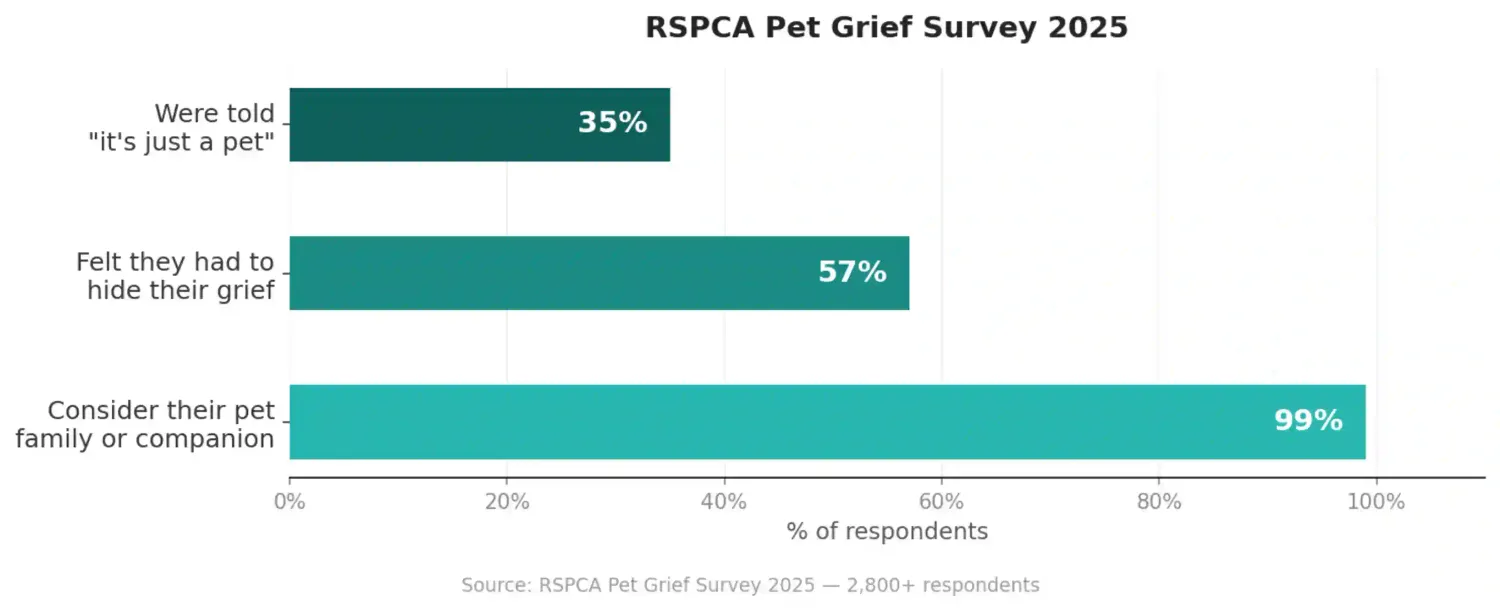
The results were striking. Over 99% of people said they considered their pet to be family, a best friend, or a companion. Fewer than 1% described their pet as "just a pet."
Yet nearly 6 in 10 people said they had felt they had to hide their grief. The same number said they believed there was a stigma around grieving for an animal. More than a third had been told - or sensed that others were thinking - "it's just a pet."
That gap between how much people genuinely grieve and how much the world allows them to is what grief researchers call disenfranchised grief.
It's grief that isn't fully acknowledged by the people around you - grief that society hasn't given a proper space to.
And it can make the loss significantly harder to carry, because you end up not only grieving your pet but also managing other people's discomfort with how much you're grieving.
If you've experienced that - if someone has minimised your loss or made you feel like you should be over it by now - please know that they're wrong.
Not unkind, necessarily, but wrong. Your grief is valid. The love that created it was real. And you are far from alone in feeling this way.
How Long Does Pet Grief Last?
This is the question most people really want answered. And the honest answer is: there is no set timeline, and anyone who gives you one is oversimplifying.
That said, research does give us a general picture of what most people experience.
The most intense period of grief - the raw, acute, can barely function stage - typically lasts between one and three months after losing a pet.
During this time it's common to feel shock, deep sadness, difficulty concentrating, changes in appetite and sleep, and a general sense that the world has become slightly unreal.
After that first phase, grief doesn't disappear - it changes shape. Most people find that general grief symptoms continue for somewhere between six months and a year, gradually softening over time rather than ending suddenly.
Some people find the grief lasts longer than that - two years or more - and that's entirely normal too, particularly when the bond was very close or the loss was sudden or traumatic.
What makes pet grief particularly disorienting is that it doesn't move in a straight line. You might have a good week and think you're through the worst of it, then find your pet's old lead in a coat pocket and be completely undone.
You might feel okay most of the time and then hear a sound they used to make - the jingle of a collar, a noise that sounded like their particular bark - and feel the loss as acutely as the first day.
Grief researchers describe this as the wave model of grief - rather than steadily improving over time, grief moves in waves that gradually become less frequent and less overwhelming, but never entirely stop.
Anniversaries, birthdays, significant dates, the first Christmas without them - these can bring grief surging back even years after the loss. That isn't a sign that you haven't healed. It's a sign that you loved them.
The Factors That Affect How Long Your Grief Lasts Include:
The depth of the bond
The stronger the attachment, the longer and more intense the grief is likely to be. A pet who has been your companion for fifteen years and who you've been entirely responsible for is going to leave a far bigger absence than one you had briefly.
How the death happened
A sudden, unexpected death - an accident, a sudden illness - tends to create more intense and prolonged grief than a death that came after a long illness, where there was time to prepare. Sudden loss involves shock as well as grief, and shock takes time to process on its own.
Whether you carry guilt
Guilt is one of the most common and most painful complications of pet loss - particularly after euthanasia. If you're carrying guilt alongside your grief, the healing process tends to take longer, because you're dealing with two things at once.
Your support system
Having people around you who genuinely understand the bond you had with your pet makes a significant difference. Feeling understood in your grief is one of the most healing things there is.
Your own personality and coping style
Some people process grief by talking about it, by crying, by surrounding themselves with memories. Others process it quietly and privately. Neither way is wrong, and neither way predicts how long the grief will last.
The most useful question isn't "when will this be over?" It's "is this softening over time, even slowly?" If the answer is yes - even slightly, even on most days - that's healing happening, even when it doesn't feel like it.
The Stages of Pet Loss Grief
You've probably heard of the five stages of grief - denial, anger, bargaining, depression, acceptance.
This model, developed by Elisabeth Kübler-Ross, has become so widely known that people sometimes treat it as a checklist, worrying that they're skipping stages or doing grief wrong because their experience doesn't match the sequence.
Let's clear that up immediately: grief is not linear. The stages are not a roadmap you follow in order.
They're simply descriptions of emotional experiences that many grieving people recognise and you might feel several at once, revisit some multiple times, or barely experience others at all.
There is no wrong way to grieve.
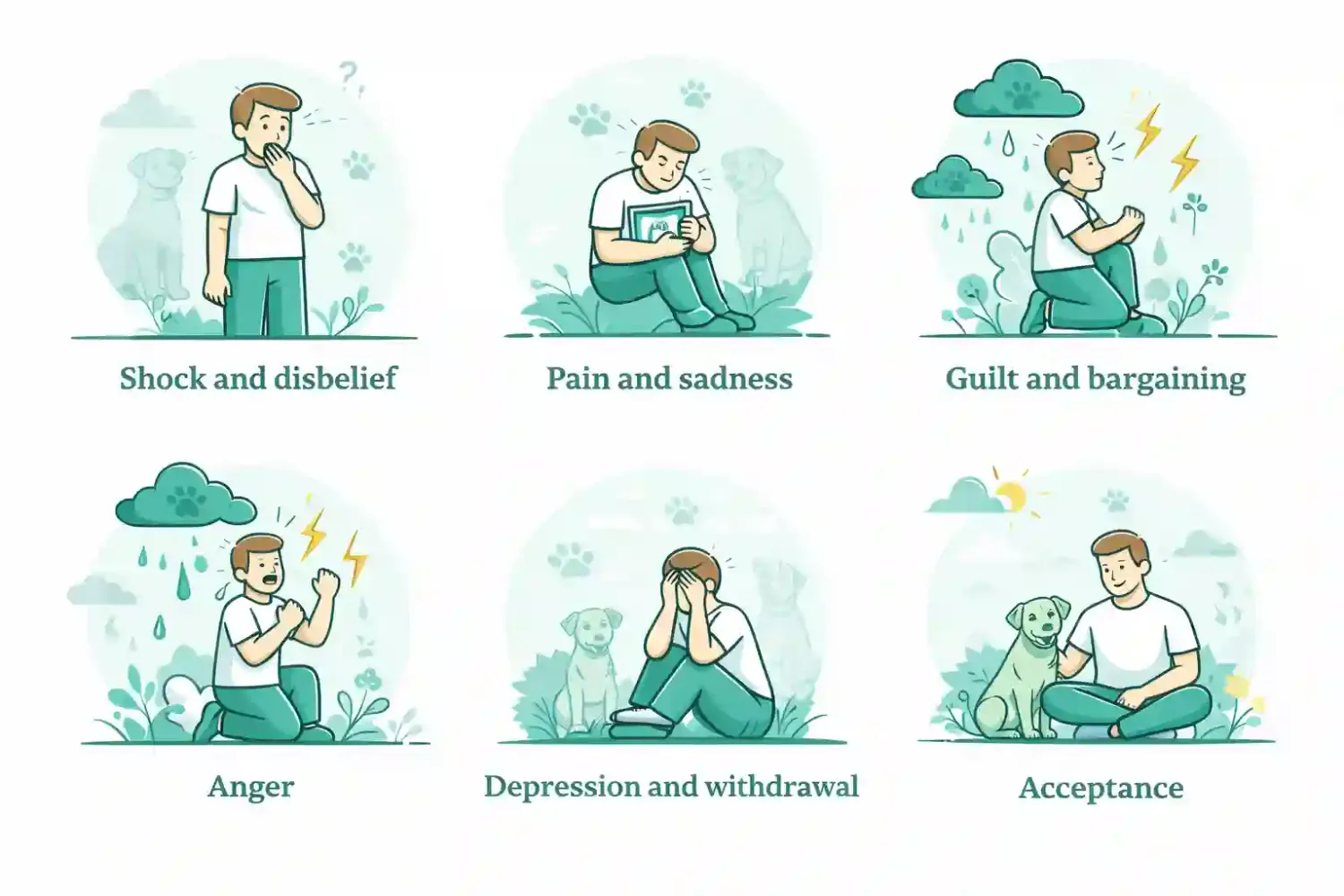
Shock and disbelief
Even when a pet's death is expected - when they've been ill for a long time - the moment it actually happens can feel unreal.
You might find yourself reaching for them out of habit, turning to speak to them, setting their food bowl out before remembering. This isn't confusion. It's your mind taking the time it needs to catch up with a reality that hasn't fully landed yet.
Pain and sadness
This is the heaviest part - the deep ache that sits in your chest, the crying that catches you off guard, the moments where the loss feels unbearable. This is grief doing its work. As painful as it is, allowing yourself to feel it rather than pushing it away is part of healing.
Guilt and bargaining
Guilt is almost universal after pet loss, and almost always involves some version of "what if." What if I'd noticed sooner. What if I'd chosen a different vet.
What if I waited longer. What if I hadn't waited so long. These thoughts are your mind trying to make sense of something that doesn't feel like it should have happened. They're not evidence that you did anything wrong.
Anger
Sometimes grief comes out as anger - at the vet, at the circumstances, at yourself, at the unfairness of pets having such short lives compared to ours.
Anger is a completely normal part of grief and doesn't mean you're coping badly. It often softens as the sadness underneath it gets more room to breathe.
Depression and withdrawal
Feeling low, flat, unable to find pleasure in things you normally enjoy - this is common in grief and doesn't necessarily mean clinical depression.
It means you've lost something important and your whole system is adjusting. If these feelings persist for a long time without easing at all, that's worth talking to someone about.
Acceptance
Acceptance doesn't mean being okay with what happened or no longer missing your pet.
It means gradually finding a way to carry the loss and still live your life - finding that memories bring something other than just pain, that you can talk about them without falling apart, that the shape of your days has begun to reform around the space they left.
Most people move through these experiences in their own order and at their own pace. The important thing is not to compare your grief to anyone else's.
Is It Normal to Feel This Upset?
Yes. Completely, absolutely, without question - yes.
If you're wondering whether your grief is too much, too intense, lasting too long - please hear this: the research consistently shows that pet loss grief is genuinely comparable to the grief experienced after losing a human loved one.
This isn't sentiment. It's backed by data.
A 2024 study conducted with a nationally representative sample of UK adults found that among people who had lost both a pet and a human, 21% said the loss of their pet was the most distressing bereavement they had experienced.
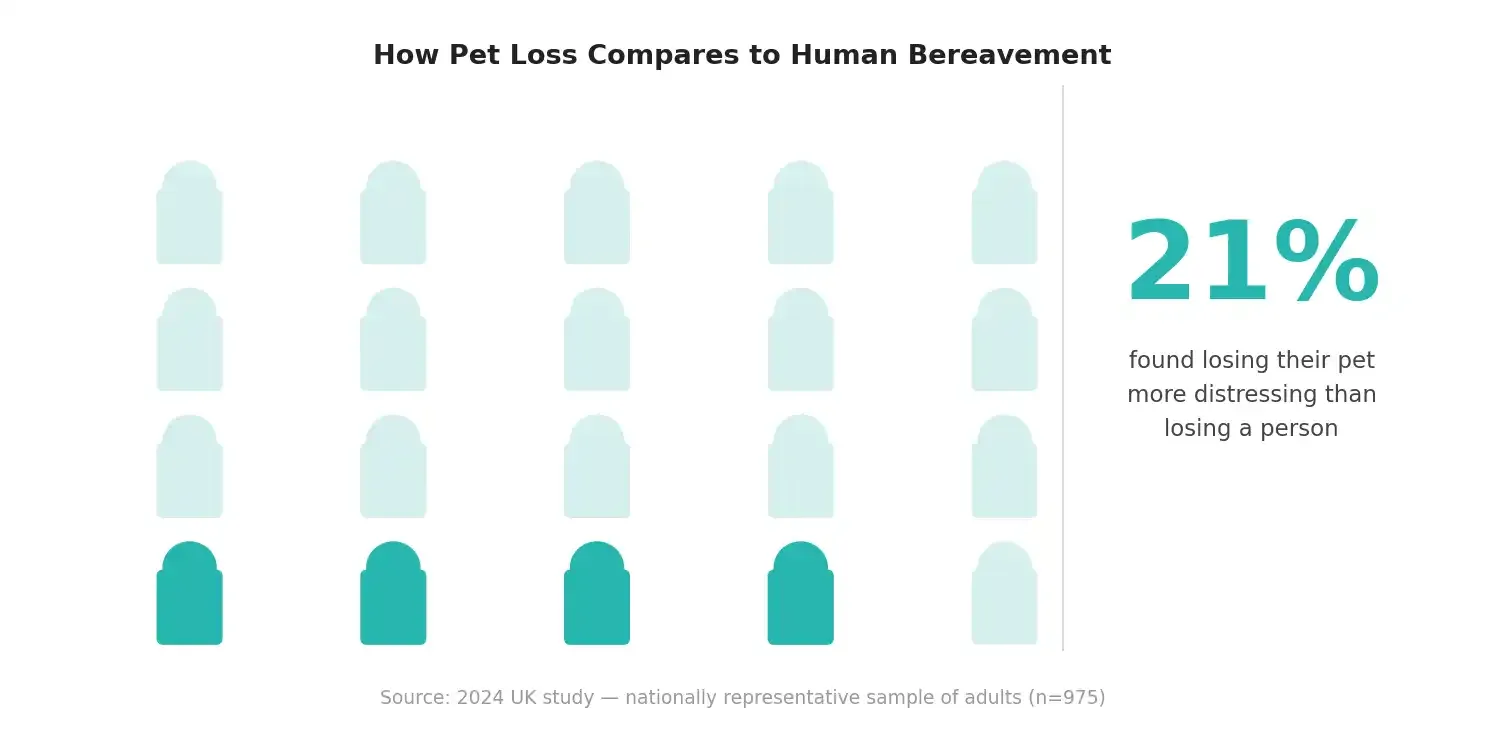
More than one in five people found losing a pet harder than losing a person. That doesn't mean they loved people less.
It means the bond with a pet is a different kind of bond - one built on daily presence, unconditional love, and a level of emotional simplicity that human relationships rarely achieve.
It's also worth knowing that some people find pet grief more intense precisely because there are fewer social structures around it.
When a person dies there is usually a funeral, a period of acknowledged mourning, people asking how you are, perhaps time off work.
When a pet dies, most people are expected to be back at their desks the next morning. The grief has nowhere obvious to go, which can make it feel even more overwhelming.
If you're feeling more upset than you expected - you're not unusual. You're not weak. You're grieving, and you loved them.
Guilt After Losing a Pet - You Are Not Alone
Guilt deserves its own section because it's one of the most common and least talked-about parts of pet loss.
Almost everyone who has lost a pet has felt some version of it, but people rarely admit it because they worry it means something about them.
It doesn't. Guilt after losing a pet is almost universal - and it takes many different forms.
Guilt after euthanasia...
... is probably the most common. Did I do it too soon? Did I wait too long? Was I making the decision for them or for myself? These questions are agonising, and there are no clean answers.
What you can hold onto is this: if you chose euthanasia for your pet, you did so because you loved them and you didn't want them to suffer. That is one of the most selfless things a person can do for an animal.
The fact that it left you questioning yourself afterwards is not evidence that you did the wrong thing. It's evidence that you took the responsibility seriously.
Guilt about not being there.
Some people weren't present when their pet died - perhaps it happened suddenly, or they were at work, or they couldn't face being in the room.
If this is you, please know that pets don't experience your absence in the way you fear. What mattered to them was the whole of the life you gave them - not whether you were holding their paw at the very last moment.
Guilt about moving on.
Feeling better as time passes, being able to laugh again, thinking about getting another pet - these can all come with a wave of guilt, as though feeling okay betrays your love for the one you lost.
It doesn't. Healing isn't forgetting. The love doesn't go anywhere just because the acute pain begins to ease.
Guilt about feeling relieved.
If your pet had been very ill or in pain for a long time, it's entirely natural to feel a sense of relief when they're no longer suffering.
Feeling that relief alongside grief doesn't make you a bad person. It makes you someone who cared enough about their wellbeing to be glad they're no longer in pain.
Whatever form your guilt is taking - try to speak to it with the same kindness you'd offer a friend. You did your best. You loved them. That was enough.
Coping With Pet Loss - What Actually Helps
There are things that genuinely help when you're grieving a pet - and they're not always the things people expect. Here's what the research and experience of thousands of people suggests actually makes a difference.
Let yourself grieve properly.
This sounds obvious but it's harder than it sounds, particularly when the world is sending signals that you should be fine by now.
Give yourself full permission to feel what you're feeling. Cry when you need to cry. Talk about your pet as much as you need to. Look at photos. Don't rush yourself out of the grief because it makes other people uncomfortable.
Seek out people who understand.
Not everyone will get it - and that's painful, but it's reality.
Spend your energy on the people who do understand, whether that's a friend who also loves animals, an online pet loss community, or a support group. Being truly understood in your grief is one of the most healing things there is.
Maintain your routine where you can.
The disruption to daily routine after a pet dies is one of the most underestimated parts of the loss.
If you can maintain some structure - regular mealtimes, going outside, keeping to a rough schedule - it gives you something to anchor to when everything else feels unmoored.
Create a small ritual or memorial.
Marking your pet's life in some way helps many people. This doesn't have to be elaborate - a favourite photo in a new frame, a candle you light on the anniversary of their death, planting something in the garden, making a small donation to an animal charity in their name.
Having something tangible to do with your love for them can help when the grief feels too big to just sit with.
If you're looking for ideas, our guide to pet memorials, remembrance and keepsakes has some gentle suggestions.
Be kind to your body.
Grief is physically exhausting in a way that surprises most people. Try to eat, sleep, and move your body even when it's the last thing you feel like doing.
Not to be healthy or productive - just to keep yourself going.
Don't let anyone rush you.
People who love you may try to speed up your healing because watching you grieve is painful for them. That's not your problem to manage. You don't owe anyone a timeline.
How Do Other Pets Cope With the Loss?
If you have other animals in your home, you may have noticed changes in them after losing one of their companions.
Dogs and cats absolutely do show signs of grief - this is well observed and well documented, even if we can't know exactly what they're experiencing.
Signs of grief in surviving pets can include changes in appetite, sleeping more than usual, searching the house or garden, being more clingy than normal, vocalising more, or seeming generally low and flat.
These behaviours usually ease over time as your surviving pet adjusts to the new normal.
The most helpful things you can do for a grieving pet are the same things that help humans - maintain their routine as closely as possible, give them extra attention and reassurance, and be patient with any changes in their behaviour.
They're adjusting too, in their own way.
When Should I Seek Extra Support?
Most pet grief, however intense, eases gradually over time without professional intervention.
But sometimes grief becomes something more - something that genuinely needs extra support. There's no shame in that. It just means the loss was very deep, or other things in your life made it harder to carry.
Signs that you might benefit from additional support:
Your grief is not softening at all after several months, or it's intensifying rather than easing
You're unable to function in daily life - unable to work, eat, sleep, or manage basic tasks - for an extended period
You feel completely isolated and unable to talk to anyone about how you're feeling
You're having thoughts of harming yourself
Where to find support in the UK:
The Blue Cross Pet Bereavement Support Service is a free, confidential service run by trained volunteers who genuinely understand pet loss.
You can call them on 0800 096 6606, use their webchat, or email them. They're available every day of the year, from 8.30am to 8.30pm. There is no judgement, no time limit, and no expectation that you should be feeling anything other than what you're feeling.
Pet bereavement counsellors are also available - these are therapists who specialise specifically in animal loss and understand it in a way that a general counsellor may not.
And if you're genuinely struggling with your mental health - not sleeping for weeks, unable to eat, feeling hopeless - please speak to your GP. Pet loss can trigger or worsen depression and anxiety, and there is no reason to deal with that alone.
Moving Forward - What Healing Actually Looks Like
Healing after pet loss doesn't look the way people expect it to. It doesn't arrive on a particular day. It doesn't mean you stop missing them. It doesn't mean the grief disappears.
What it actually looks like - for most people - is that the grief gradually changes shape.
The acute, breathtaking pain of the early weeks softens into something that hurts differently. The memories that used to bring only sadness start to bring something else alongside the sadness - warmth, gratitude, even laughter.
You find yourself able to talk about them without falling apart every time. You stop dreading coming home to an empty house quite so much.
None of this happens on a schedule. And none of it means you've forgotten them or moved on in the way that phrase is often meant.
The love you had for your pet doesn't go anywhere. It just finds a new place to live - in a photo on the mantelpiece, in the way you still notice dogs that look like them, in the story you tell someone years from now about the funniest thing they ever did.
There's no right answer to when or whether to get another pet.
Some people find that welcoming a new animal relatively soon helps them heal - not as a replacement, but as a new beginning. Others need much longer, or decide they don't want another pet at all. Both are completely valid.
The only thing that matters is that the decision comes from the right place - genuine readiness, not pressure from other people or an attempt to outrun the grief.
Whatever you decide and however long it takes - be patient with yourself. Grief is the price of love. And loving them was worth every bit of it.
If you have recently lost a pet and need to find a pet cremation service, Pet Loss Aftercare can help during this difficult time.
When you feel ready, you can browse pet cremation and aftercare providers by location to see what services are available in your area.
Pet Cremation Providers In England
- Bedfordshire
- Berkshire
- Bristol
- Buckinghamshire
- Cambridgeshire
- Cheshire
- Cornwall
- Cumbria
- Derbyshire
- Devon
- Dorset
- Durham
- East Riding of Yorkshire
- East Sussex
- Essex
- Gloucestershire
- Greater London
- Greater Manchester
- Hampshire
- Herefordshire
- Hertfordshire
- Isle of Wight
- Kent
- Lancashire
- Leicestershire
- Lincolnshire
- Merseyside
- Norfolk
- North Yorkshire
- Northamptonshire
- Northumberland
- Nottinghamshire
- Oxfordshire
- Rutland
- Shropshire
- Staffordshire
- Somerset
- South Yorkshire
- Suffolk
- Surrey
- Tyne and Wear
- Warwickshire
- West Midlands
- West Sussex
- West Yorkshire
- Wiltshire
- Worcestershire
Pet Cremation Providers In Scotland
Pet Cremation Providers In Wales
Pet Cremation Providers In Northern Ireland
FAQs - Questions People Ask About Coping With Pet Loss
Because the love was real - and the bond you had was genuinely unique. Pets offer unconditional, uncomplicated companionship that's woven into the fabric of your daily life. When they die you lose not just them but the shape of your days, the routine you built around them, and a relationship that asked nothing of you except to be loved back. That kind of loss is enormous, regardless of what anyone else thinks.
Most people experience the most intense grief in the first one to three months. General grief - the waves of sadness, the moments of being caught off guard - often continues for six months to a year, sometimes longer. There is no fixed timeline. The more useful question is whether your grief is softening over time, even slowly. If it is, you're healing - even on the days it doesn't feel like it.
Completely normal. Grief has no deadline. Crying months - or even years - after losing a pet is not a sign that something is wrong with you. Anniversaries, familiar places, finding something that belonged to them - these can all bring grief flooding back long after the acute phase has passed. It doesn't mean you're not healing. It means you loved them.
Yes, and you're not alone in this. A 2024 study of UK adults found that more than one in five people who had lost both a pet and a human said the pet loss was the most distressing bereavement they experienced. The bond with a pet is different from human relationships - not lesser, just different. Feeling deeply bereaved after losing a pet is entirely valid.
Being allowed to grieve properly - without rushing or minimising - is probably the most important thing. Beyond that, connecting with people who genuinely understand the bond you had makes a real difference. Maintaining some routine, creating a small memorial, and being patient with yourself all help. And if you need to talk to someone, the Blue Cross Pet Bereavement Support Service is free, confidential and available every day on 0800 096 6606.
Yes, and it's almost universal. Whether it's guilt about the timing of euthanasia, not being there at the end, or feeling relieved that they're no longer suffering - guilt is one of the most common parts of pet loss. It doesn't mean you did anything wrong. It means you cared deeply about them and took your responsibility to them seriously. Try to speak to that guilt with the same kindness you'd offer a friend who was feeling the same way.
When you feel genuinely ready not when other people think you should be, and not as a way of trying to fill the gap before you've had time to grieve. For some people that's relatively soon. For others it takes much longer, or they decide they don't want another pet at all. There's no right or wrong answer. A new pet is not a replacement they're a new relationship, when you're ready for one.
The Blue Cross Pet Bereavement Support Service offers free, confidential support by phone, webchat and email every day from 8.30am to 8.30pm - call 0800 096 6606. Pet bereavement counsellors are also available if you'd like more ongoing support. If your grief is significantly affecting your mental health, your GP is also a good first step. You don't have to navigate this alone.
More Information You May Find Helpful
Do you provide pet cremation services in the UK?
Pet Loss Aftercare - a resource created by pet owners, for pet owners 💛
Found this page helpful?



Created with ©systeme.io