

How to Know When It's Time - A Guide to Your Pet's Quality of Life
If you have found this page, chances are you are watching someone you love change.
Maybe it has been gradual - a little slower on walks, a little less interested in food, a little quieter than they used to be. Or maybe something has shifted more suddenly and you are trying to make sense of what you are seeing.
Either way, you are asking one of the hardest questions a pet owner ever has to face.
There is no single right answer to it. There is no moment that announces itself clearly.
And the fact that you are here, asking this question and looking for guidance, already says everything about how much you care about your pet's wellbeing.
This guide is here to help you understand what to look for, how to think about what you are seeing, and how to have an honest conversation with your vet when you feel ready.
It will not tell you what to decide - only you, alongside your vet, can do that. But it might help you feel a little clearer and a little less alone.

According to the RSPCA's Pet Grief Survey in 2025, nearly 40% of pet owners said they struggled with knowing when the right time was.
You are certainly not alone in asking this question.
The Signs That Something May Have Changed
Pets are remarkably good at carrying on. They adapt, they compensate, and they often hide discomfort in ways that make it very easy to miss what is happening - particularly cats, who are experts at masking pain and illness until it becomes impossible to hide.
This is why knowing your own pet's 'normal' is so important. The changes that matter are not always dramatic. Often they are quiet, gradual shifts from what used to be ordinary for them.
Changes in behaviour
Behaviour is usually the first thing to shift and often the easiest to overlook because the changes happen so slowly.
You might notice your pet sleeping more than usual - not just resting, but rarely fully awake. They might show less interest in the things they used to love.
A dog who used to pull on the lead with excitement might now hang back or stop wanting to go at all. A cat who used to greet you at the door might stay put in their bed. Toys that once brought out their spark might be ignored completely.
Some pets withdraw - hiding in places they do not usually go, seeming to want quiet and solitude. Others do the opposite and become unusually clingy, wanting to stay close in a way that feels different to their normal affection. Both can be signs that something has shifted.
You might notice restlessness - an inability to settle or get comfortable, pacing, or seeming unsettled even at rest. Disorientation in familiar surroundings.
Unusual vocalisations that seem to express something beyond their usual communication - whimpering, howling, or crying that is out of character.
None of these things on their own necessarily means the worst. But taken together, over time, they paint a picture worth paying attention to.
Physical signs
Alongside changes in behaviour, physical changes often develop gradually. Again, the key is knowing what is normal for your individual pet and noticing what has shifted from that baseline.
A loss of appetite or reluctance to eat is one of the more significant signs. Pets who have always been enthusiastic about food and suddenly show little interest are telling you something.

Weight loss that happens over weeks or months - rather than suddenly - can be easy to miss until you look back at photographs or feel how much lighter they seem.
Difficulty moving is something most owners notice clearly - struggling to stand up from lying down.
Or reluctance to climb stairs, stiffness or lameness, or simply moving more slowly and carefully than they used to.
Changes in their coat or grooming habits can also be significant - a previously immaculate cat who is no longer grooming themselves, or a dog whose coat seems dull and unkempt.
Signs that suggest pain can be subtle. A hunched or tense posture. Flinching or reacting when touched in places that did not used to bother them. Reluctance to be handled.
Changes in breathing - laboured, shallow, or irregular breathing at rest. Incontinence or difficulty reaching their usual toileting spot.
The signs that are easy to miss...
The hardest signs to catch are the ones that creep up gradually. Because you see your pet every day, small changes can be almost invisible until you look back at where they were six months ago.
This is why some vets recommend keeping a simple daily diary - just a line or two each day about how your pet seemed.
Were they comfortable?
Did they eat?
Did they engage with you?
Did they seem in pain?
Over time, patterns emerge that can be incredibly helpful when you are trying to make sense of what you are seeing.
It is also worth knowing that cats are particularly good at hiding how they feel. Their instinct to mask vulnerability runs very deep.
By the time a cat is showing obvious signs of discomfort, they have often been managing it quietly for some time. If you have a cat and something feels slightly off even if you cannot quite put your finger on what, trust that feeling and talk to your vet.
The Good Days And Bad Days Question
If you ask most vets how they think about quality of life at the end of a pet's life, many of them will come back to a simple question:
"Are there more good days than bad ones?"
It sounds almost too simple. But it is probably the most honest and useful framework there is - because it does not ask you to be clinical or objective about something that is inherently deeply personal.
It asks you to look at your pet's life as a whole and ask whether, on balance, they are still experiencing more comfort and joy than pain and difficulty.
A good day might look like: they ate their meal without encouragement, they wagged their tail when you came in, they settled comfortably in their usual spot, they seemed at ease.
A bad day might look like: they struggled to get up, they refused food, they seemed distressed or restless, they were clearly uncomfortable despite medication.
No two days will be identical. And one difficult day does not mean the answer is clear - just as one good day does not mean everything is fine. What matters is the pattern over time.
This is where a diary becomes genuinely valuable. When you write down each day simply - good, mixed, or difficult - you start to see things more clearly than memory alone allows.
Memory tends to anchor to the most recent days, or to the best days, which can make it hard to see the overall picture.
One of the things vets who specialise in end of life care have observed over many years is this:
"owners who have been through the loss of a pet before tend to make the decision sooner the next time."
This is not because they love that pet less. But because they have seen what waiting too long actually costs - in terms of their pet's comfort and their own grief afterwards. Most owners who feel they waited too long carry that with them.
That is not said to rush you or create pressure. It is said so you know that acting when the time feels right - even if a small part of you worries it might be too soon - is almost always a more compassionate choice than waiting until there is no choice left.
Understanding the HHHHHMM Quality of Life Scale
One of the most widely used tools in veterinary end of life care is something called the HHHHHMM Quality of Life Scale.
It was developed by Dr Alice Villalobos, a veterinary oncologist, in 2004 as part of a programme she called Pawspice - a palliative and hospice care approach for terminally ill pets.
The name stands for seven factors: Hurt, Hunger, Hydration, Hygiene, Happiness, Mobility, and More good days than bad. Each one is scored on a scale of one to ten, where ten represents the best possible condition.
You do not need to use it like a test with a definitive result. Think of it more as a structured way of looking at your pet's life across different areas - a way of making something that feels overwhelming feel a little more manageable.
Many owners find it helpful to score their pet weekly, over several weeks, so they can see how things are changing over time rather than trying to assess everything from a single snapshot.
❤️🩹Hurt - is your pet comfortable?
The most important factor of all. Is your pet's pain being managed effectively? Can they breathe comfortably? Are they resting without obvious distress?
A score of ten here means pain is well controlled and your pet seems comfortable. A score towards one means they are in significant discomfort that medication or treatment is not adequately managing.
If this score is consistently low despite your vet's best efforts, it carries considerable weight.
🥣🦴Hunger - are they eating well enough?
Is your pet eating enough to maintain reasonable strength and nourishment? Are they eating on their own, or do they need encouragement, hand feeding, or special preparation to get anything down?
A score of ten means they are eating well. A score towards one means they are barely eating despite your best efforts. A pet who has stopped eating altogether is telling you something important.
💦Hydration - are they staying hydrated?
Is your pet drinking enough? Are there signs of dehydration - dry gums, skin that does not spring back when gently pinched, sunken eyes? Your vet can show you how to check for dehydration if you are unsure.
🧽Hygiene - can they stay clean and comfortable?
Can your pet keep themselves reasonably clean? Can they move away from any accidents? Are there pressure sores from spending too much time lying in one position?
Is there anything about their physical condition - wounds, infections, odour - that is causing them distress or discomfort?
This factor matters not just for practical reasons but for dignity. Most pets have a strong instinct for cleanliness and can find it distressing when they cannot maintain it.
🌞Happiness - is there still a spark?
This is perhaps the most important and the most difficult to score. Does your pet still show interest in the people and things they love?
Do they respond to you? Is there still something - a tail wag, a purr, a moment of engagement - that tells you they are still present and connected?
A pet who has withdrawn completely, who no longer responds to the things that used to bring them joy, who seems absent even when they are there - that is important information.
🐾Mobility - can they get around?
Can your pet move independently?
Can they get up, reach their food and water, get to their usual sleeping spot?
Do they need significant assistance for basic movement?
Are they having falls, seizures, or episodes of collapse?
Mobility matters not just practically but for a pet's sense of themselves. Many pets find a significant loss of independence distressing.
📅More good days than bad
Bringing everything together - does the overall picture suggest your pet is experiencing more comfort and engagement than pain and difficulty? When you look at the week as a whole, was it a good week, a mixed week, or a difficult week?
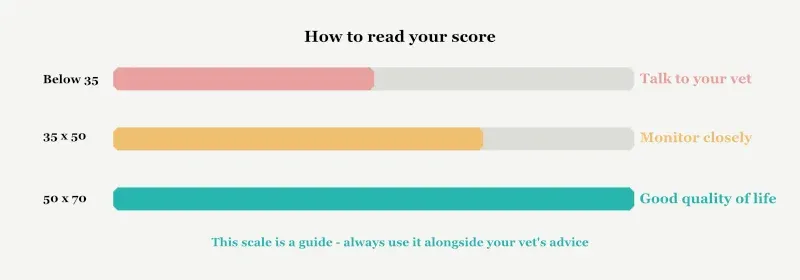
Scoring guidance: A combined score of 35 or above out of 70 is generally considered to indicate an acceptable quality of life. A score that is consistently falling below 35 is a signal that the time has come to have an honest conversation with your vet.
This scale is a guide not a verdict - always use it alongside your vet's clinical knowledge of your pet's specific condition.
What Your Vet Can Tell You That You Cannot See Yourself
Your vet brings something to this that you cannot - clinical knowledge of what your pet's particular condition typically looks like as it progresses, and the ability to assess pain levels that pets are often very good at hiding from the people who love them most.
Many owners delay calling their vet because they are afraid of what they might be told.
The RSPCA's Head Vet Rebecca Ashman put it well when she said:
"people sometimes put off calling because they worry they will be told to put their pet to sleep"
But vets are there to support both you and your pet, which might mean treatment to improve their quality of life, or discussing whether it is time to consider euthanasia.
Your vet is not there to make this decision for you or to push you towards anything. They are there to help you understand what you are seeing and what your options are.
Do not be afraid to call, simply to talk.
You do not need to have reached a conclusion to have the conversation. Many vet practices now offer specific quality of life consultations - a dedicated appointment to discuss where your pet is and what the path ahead might look like.
It is worth asking whether your practice offers this, and worth booking one before you feel you need it rather than after.
The Emotions That Come With This
Whatever you are feeling right now - all of it is valid. There is no right or wrong way to feel when you are facing this.
Guilt is almost universal. Whether you are worried you are considering this too soon, or whether you are worried you have waited too long, guilt tends to sit alongside almost every part of this experience.
It does not mean you are doing anything wrong. It means you love your pet and you are taking this seriously.
Relief is also completely normal - and does not mean what some people worry it means.
Feeling a sense of peace at the idea that your pet will no longer be suffering is not a betrayal. It is an expression of love.
The Blue Cross puts it simply - the decision for euthanasia is taken with your pet's best interests at heart to avoid them suffering.
Doubt and second-guessing tend to come in waves. They are part of grief, not evidence that you have made a wrong decision.
What most vets and those who work in end of life care will tell you - gently but honestly, is this... it is almost always kinder to act a little earlier than you think you need to than to wait until there is clearly no choice left.
A pet who passes peacefully, calmly, surrounded by the people they love, at a moment chosen with care - that is a profound act of love, not a failure.
You are not choosing when your pet's life ends. You are choosing how.
You Do Not Have to Figure This Out Alone
This is one of the hardest things you will ever navigate as a pet owner. Please do not try to do it entirely by yourself.
Talk to your vet. Talk to someone close to you. And if you are struggling to process what you are feeling - before, during, or after - there is genuine support available.
The Blue Cross Pet Bereavement Support Line is free, confidential, and available every day: 0800 096 6606
You can also find pet bereavement counsellors across the UK - people who understand exactly what you are going through and who can offer a quiet, safe space to talk.
When You Are Ready - Practical Next Steps
When the time comes, there are decisions to make - about aftercare, about cremation, about how you want to say goodbye.
You do not need to make any of those decisions now. But when you feel ready, these guides are here to help:
There is no pressure and no rush. Everything here will be here whenever you need it.
Frequently Asked Questions
Pets are very good at hiding pain, particularly cats. Signs to watch for include changes in posture such as hunching or stiffness, reluctance to be touched in places that did not used to bother them, changes in behaviour such as withdrawing or becoming unusually still, altered breathing, loss of appetite, and a general sense that something is not right. If you suspect your pet is in pain, contact your vet - they can assess pain levels in ways that are not always visible to even the most attentive owner.
No. Thinking about this before you feel you have to is one of the kindest things you can do - for your pet and for yourself. It allows you to have conversations with your vet, understand your options, and be more prepared when the time comes. Many vets now discuss end of life as a routine part of care for older pets. There is nothing morbid about thinking ahead.
This is more common than most people realise and it can add a painful layer to an already difficult situation. Different people process this differently, some want to act to prevent suffering, others need more time to be ready. Try to approach it as a shared conversation rather than a disagreement, and lean on your vet to help frame the discussion around your pet's wellbeing rather than around individual feelings. If it helps, a quality of life assessment done together - everyone scoring independently and then comparing, can sometimes make the conversation feel more grounded.
This is entirely your decision and there is no right or wrong answer. Many owners find it deeply important to be present, to offer comfort and familiarity in their pet's final moments. Others find they cannot face it, for completely understandable reasons. If you choose not to be there, or circumstances mean you cannot be, please do not carry guilt about that. Your pet has known your love throughout their whole life. That does not change.
Honestly and gently, in language that is appropriate for their age. Children generally cope better with honest, clear explanations than with confusing phrases or half-truths. Allow them to ask questions in their own time and let them be involved in any remembrance if they want to be. We have written a fuller guide on helping children cope with the loss of a pet which you might find helpful.
When the time comes there are several options to consider - individual cremation, communal cremation, attended cremation, and home burial, each with different implications in terms of cost, what is returned to you, and what feels right for your family. Our guides cover all of these clearly and without pressure.
→ What To Do Next If Your Pet Has Just Died - Complete Guide
Need To Find A Pet Crematorium Near You?
If you have recently lost a pet and need to find a pet cremation service, Pet Loss Aftercare can help during this difficult time.
When you feel ready, you can browse pet cremation and aftercare providers by location to see what services are available in your area.
Pet Cremation Providers In England
- Bedfordshire
- Berkshire
- Bristol
- Buckinghamshire
- Cambridgeshire
- Cheshire
- Cornwall
- Cumbria
- Derbyshire
- Devon
- Dorset
- Durham
- East Riding of Yorkshire
- East Sussex
- Essex
- Gloucestershire
- Greater London
- Greater Manchester
- Hampshire
- Herefordshire
- Hertfordshire
- Isle of Wight
- Kent
- Lancashire
- Leicestershire
- Lincolnshire
- Merseyside
- Norfolk
- North Yorkshire
- Northamptonshire
- Northumberland
- Nottinghamshire
- Oxfordshire
- Rutland
- Shropshire
- Staffordshire
- Somerset
- South Yorkshire
- Suffolk
- Surrey
- Tyne and Wear
- Warwickshire
- West Midlands
- West Sussex
- West Yorkshire
- Wiltshire
- Worcestershire
Pet Cremation Providers In Scotland
Pet Cremation Providers In Wales
Pet Cremation Providers In Northern Ireland
Do you provide pet cremation services in the UK?
Pet Loss Aftercare - a resource created by pet owners, for pet owners 💛
Found this page helpful?




Created with ©systeme.io