

Do Dogs and Cats Grieve? How to Help a Surviving Pet After Loss (UK Guide)
Yes - dogs, cats, rabbits, guinea pigs, horses and other family pets can all grieve after losing a companion animal.
A 2022 study published in Scientific Reports found that 86% of dog owners observed significant behavioural changes in their surviving dog following the death of a companion, confirming what many pet owners already know from experience: the grief in your household belongs to your animals too.
When a pet dies, that grief does not belong to you alone. Your surviving animals are acutely aware that something has changed, and many will show it in ways that are measurable, documented, and worth taking seriously.
This guide explains what to look for in each species, what helps, and when to seek professional support.
What The Science Tells Us About Animal Grief
The evidence that animals grieve is now strong enough to move beyond anecdote. A landmark study published in Scientific Reports surveyed 426 adults who had owned at least two dogs, one of whom died while the other was still alive.
86% of owners observed significant negative behavioural changes in their surviving dog after the death of their canine companion - making this one of the largest and most compelling datasets on the subject.
Crucially, the same study found that one of the strongest predictors of negative behavioural change in the surviving dog was not the closeness of the bond between the two dogs - it was the owner's own grief and anger.
Your emotional state directly affects your surviving animal. The two griefs are not separate. They are intertwined, and understanding this is one of the most important things you can take from the research.
A 2026 study published in PLOS One using a nationally representative UK sample of 975 adults found that 7.5% of people who had lost a pet met the clinical criteria for Prolonged Grief Disorder - comparable to grief following the loss of a close human friend.
Grief after animal loss is real, clinically significant, and runs in both directions. You are grieving your pet. Your surviving animals may be grieving too.
How Grief Looks Different Depending On Your Pet
Grief is not the same across species. The signs, the risks, and the right response vary significantly depending on which animal you are caring for. Here is what is genuinely distinct for each.
Do Dogs Grieve Other Dogs?
Yes - and dogs are the most researched species when it comes to companion animal grief.
Following the death of a companion dog, surviving dogs commonly show changes including playing and eating less, sleeping more, becoming more fearful, and tending to whine and bark more often.

In the Pirrone Scientific Reports study, 32% of owners reported that behavioural changes in their surviving dog lasted between two and six months, and 25% reported changes lasting longer than six months.
What makes dog grief distinctive:
Dogs are highly social animals that regulate their emotional state partly through their relationships.
When a companion dies, they lose not just a companion but a source of social cues - another presence that helped them understand their environment as safe and predictable.
This is why routine maintenance is so important for grieving dogs: it replaces some of what the companion provided.
Specific signs to watch for in dogs:
Searching behaviour - returning repeatedly to the deceased dog's bed, waiting by the door, sniffing familiar spots
Vocalisation changes - increased whining, howling, or barking, particularly in the evenings or at times when the two dogs used to interact
Appetite loss - eating is partly a social experience for dogs; some will not eat well without company
Clinginess - seeking more physical contact with you than usual
Lethargy - reduced interest in walks, play, or activities previously enjoyed
The Pirrone study also found that dogs who had a highly positive relationship with the deceased companion showed more severe grief responses than those whose relationship was more neutral - which means the dogs most likely to grieve acutely are the ones who were closest.
If your dogs were bonded companions, expect a more significant response.
One important nuance for dogs: unlike cats, dogs often benefit from the presence of another dog during the grief period.
In some cases - particularly for dogs with strong social needs - introducing a compatible companion once the acute phase has passed can genuinely help. This is a decision best made with your vet rather than immediately after the loss.
If your dog has lost you, rather than an animal companion: the experience of a dog grieving a human owner is different in important ways - different triggers, different behaviour patterns, and a different path through. That scenario deserves its own dedicated guide, which we will be publishing shortly.
Coping With Pet Loss → How Long Does Grief Last and How To Heal
Do Cats Grieve Other Cats?

Yes - but cat grief is quieter and easier to miss than dog grief, which means it is also more often overlooked.
Cats express grief differently from dogs. Where a dog may vocalise and search visibly, a grieving cat is more likely to withdraw, hide, or become unusually still.
The absence of obvious distress does not mean the cat is unaffected - it may simply mean they are processing it internally, in the way cats process most things.
What makes cat grief distinctive:
Cats are less demonstrative than dogs but form equally strong bonds. Their grief tends to be more internalised and harder to read. A cat who has lost a companion may appear fine on the surface while showing subtle changes that accumulate into a picture of distress.
Specific signs to watch for in cats:
Withdrawal and hiding - spending more time in unusual locations, avoiding rooms they previously shared with the deceased cat
Unusual clinginess - some cats become more demanding of human attention rather than less, particularly if the deceased was their primary social companion
Overgrooming - excessive licking or grooming as a self-soothing behaviour, which can lead to bald patches if prolonged
Appetite changes - eating less, or sometimes eating more as a comfort behaviour
Vocalisation - some cats become more vocal, calling out in ways that appear directed at the absent companion
Litter tray changes - stress can cause cats to miss the litter tray or change their toileting patterns
Do cats remember other cats?
Yes - and for longer than many owners expect. Research into feline cognition suggests cats have long-term associative memory, meaning they can retain memories of companions for months and potentially years.
This is relevant to grief because a cat who appears to have "moved on" may still respond to familiar scents, sounds, or locations associated with their former companion long after the acute grieving period has ended.
If your cat suddenly appears unsettled weeks or months after a loss - particularly if they encounter something that belonged to the deceased cat - this is likely memory at work rather than a new problem. It is not cause for alarm, but it is worth knowing that the absence of visible grief does not mean the absence of memory or attachment.
One important nuance for cats: unlike dogs, cats do not reliably benefit from the rapid introduction of a new companion. Cats that have lost a bonded companion often need time to adjust to the changed household dynamic before a new cat is introduced.
Introducing a new cat too soon can add stress rather than comfort, particularly in a cat who is already anxious. If you are considering getting another cat, wait until your surviving cat's behaviour has stabilised - this typically takes at least two to three months.
Do Rabbits Grieve?
Yes - and rabbit grief carries genuine physical risks that make it one of the most urgent situations covered in this guide.
Rabbits are highly social animals that form intense pair bonds. When a bonded companion dies, the surviving rabbit can be profoundly affected - and unlike dogs or cats, the consequences of grief can become life-threatening relatively quickly.

What makes rabbit grief distinctive:
Rabbits are prey animals conditioned to hide signs of weakness, which means their distress can be harder to detect than in dogs or cats.
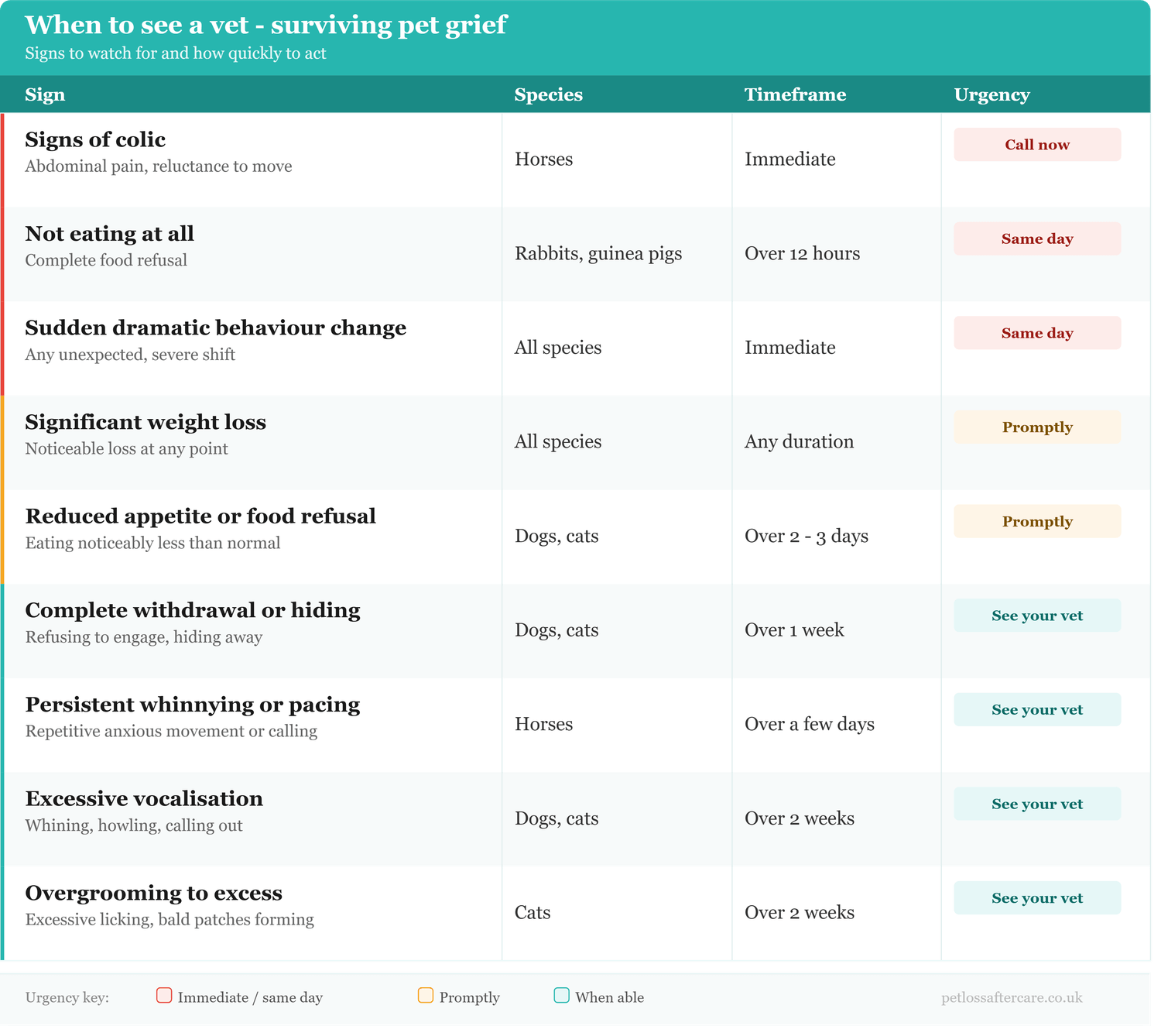
At the same time, their digestive system requires near-constant movement to function safely - a rabbit who stops eating for more than 12 hours is at risk of GI stasis, a potentially fatal condition. Grief-related appetite loss in rabbits is therefore a medical emergency, not just a welfare concern.
Specific signs to watch for in rabbits:
Lethargy - sitting hunched, reluctance to move, loss of interest in their environment
Not eating or drinking - this requires prompt veterinary attention if it persists beyond 12 hours
Sitting beside or on the deceased rabbit's resting spot - similar searching behaviour to dogs but often more static
Loss of interest in activities - toys, foraging, and exploration they previously enjoyed
Flattened posture - a general deflation of energy and engagement that experienced rabbit owners describe as the rabbit "going flat"
Showing the body: rabbit welfare organisations, including the Rabbit Welfare Association and Fund, generally recommend allowing a surviving rabbit to spend time with the body of their companion.
This is one of the clearest cases where this practice is supported - rabbits who are denied this opportunity sometimes search for their companion for extended periods, which prolongs distress. Allow the surviving rabbit to approach the body at their own pace, in a calm environment.
Getting a new companion: unlike dogs and cats, rabbits often genuinely need a new companion relatively soon after a loss - not immediately, but sooner than you might expect. A rabbit left alone for months can develop chronic stress.
Speak to a vet or rescue organisation about the right timing and the bonding process, which needs to be done carefully and on neutral territory.
Do Guinea Pigs Grieve?

Yes - and guinea pig grief is one of the least discussed but most significant welfare issues in this space.
Guinea pigs are one of the species where the advice diverges most sharply from dogs and cats.
With dogs, you are advised to wait before getting a new companion.
With guinea pigs, the opposite is often true - leaving a guinea pig alone for an extended period following the death of a companion can cause serious and lasting distress.
What makes guinea pig grief distinctive:
Guinea pigs are highly social herd animals. In their natural environment, they would never be alone - solitude is genuinely unnatural and stressful for them.
When a companion dies, the surviving guinea pig loses not just a friend but the social structure that makes them feel safe. This is a welfare issue as much as an emotional one, and it is recognised as such by the RSPCA, which does not recommend keeping guinea pigs alone.
Specific signs to watch for in guinea pigs:
Vocalisation - increased or unusual sounds, particularly calling or "wheeking" that seems directed at the absent companion
Loss of appetite - like rabbits, guinea pigs who stop eating need prompt veterinary attention
Lethargy - reduced movement, less interest in their environment
Searching behaviour - moving around their enclosure in ways that appear to be looking for the absent companion
Weight loss - a reliable indicator that stress is affecting their physical health; weigh your guinea pig regularly after a loss
Getting a new companion: this is the one species where getting a new companion sooner rather than later is often the right answer - but the introduction must be done carefully. Guinea pigs establish hierarchies and do not always accept newcomers immediately.
Contact a guinea pig rescue or a vet for guidance on the bonding process. Never simply place a new guinea pig into the existing enclosure without a proper introduction period.
The Role of Pet Bereavement Counselling → How It Can Help and Where to Find Support
Do Horses Grieve?
Yes - and horse grief is perhaps the most visible of all the species covered in this article.
Horses are large and their distress is correspondingly dramatic, and partly because the herd is the fundamental unit of equine social life.

What makes horse grief distinctive:
Horses are herd animals whose sense of safety depends on their social group. The loss of a companion - particularly a long-term stablemate - disrupts not just an individual relationship but the entire social structure the horse relies on.
This is compounded by the fact that horses often witness the circumstances of a companion's death or removal in ways that other animals do not.
Specific signs to watch for in horses:
Persistent whinnying - calling out repeatedly, particularly in the direction the companion was last seen
Pacing fence lines - walking the perimeter of their enclosure in a repetitive, anxious pattern
Reduced appetite - not eating hay or hard feed at their normal rate
Changes in social behaviour - either becoming more withdrawn from other horses in the herd, or seeking closer contact than usual
Vigilance and anxiety - appearing on high alert, startling more easily, difficulty settling
The physical risk - colic: horses experiencing acute grief are at elevated risk of stress-related colic, which is a medical emergency.
If your horse has recently lost a companion and shows any signs of abdominal pain, reluctance to move, or looking at their flank, contact your vet immediately. Do not wait to see if it resolves.
Allowing farewell: many equine vets and behaviourists support allowing the remaining horse to spend time near the deceased companion's body where this is safe and practically possible. Horses who are given this opportunity often show less prolonged searching behaviour than those who simply find their companion gone one morning.
Managing the aftermath: if your horse is now alone in a field or stable, providing consistent human contact, maintaining their routine, and where possible arranging supervised time with other horses can help significantly.
Some horses manage the transition to a new companion more readily than others - a vet or equine behaviourist can advise on the right approach for your individual animal.
Should I Show My Surviving Pet The Body?
This is a question many owners ask and feel uncertain about - and it deserves a direct answer.
For dogs and cats, many veterinary behaviourists believe that giving a surviving pet the opportunity to investigate the body of the deceased companion can help them process the loss more naturally.
Without this, some surviving pets engage in prolonged searching behaviour - returning again and again to the spots where their companion used to sleep, waiting by the door, looking for something that never arrives.
For rabbits and guinea pigs, this is more strongly recommended. Both species can show extended and distressing searching behaviour when a companion simply disappears, and allowing them to investigate the body is widely supported by species-specific welfare organisations.
For horses, allowing the remaining horse time near the body is supported by many equine vets where it is safe to do so.
Practical considerations for all species:
Only do this if the cause of death does not pose any risk of infection - ask your vet if you are unsure
Allow your pet to approach at their own pace - never force the interaction
The body may smell differently to when your pet was alive, which can cause a reaction that looks distressing but is simply your animal processing unfamiliar information
Some animals show no interest - this is also normal and does not mean the bond was weak
How Does Your Grief Affect Your Surviving Pet?
This is the part of the picture most often left out of guidance on surviving pet grief - and it is one of the most important. The Pirrone study found that owner grief and anger were among the principal predictors of negative behavioural change in surviving dogs.
While this research focused on dogs, the principle extends across species - your animals are reading your emotional state, your routine disruption, and your physical tension. When you are in acute grief, your animal is living in a household where the person they rely on for safety and predictability is visibly distressed.
What this means practically:
Try, where you can, to maintain your pet's routine even when maintaining your own feels impossible
Seek support for your own grief - not only because you deserve it, but because your recovery genuinely helps your animal's recovery
Let physical contact with your surviving pet be mutual comfort rather than one-directional
Be patient with yourself - you cannot perform composure you do not feel, but awareness of the connection is useful. You are both healing. The process runs in both directions.
How Can I Help My Surviving Pet Grieve?
Why does routine matter so much?
Routine is one of the most powerful tools available to you - and one of the simplest.
Animals experience the world through pattern and predictability.
Maintaining mealtimes, exercise schedules, play sessions, and sleeping arrangements as consistently as possible gives your surviving pet the structure they need to feel safe while the emotional adjustment happens.
Routine checklist for surviving pets:
Keep mealtimes consistent - same time, same place, same bowl or dish
Maintain exercise or activity schedules where possible
Keep sleeping arrangements the same - do not move their bed or change their space
Continue regular play or interaction sessions, even if they seem less interested
Offer calm, consistent physical contact - stroking, sitting together, quiet companionship
Avoid introducing major household changes in the weeks immediately following the loss
Keep your own emotional regulation in mind - your pet reads your state closely
Can scent help a grieving pet?
Yes - leaving a blanket, bed, or item that carries the scent of the pet who died can help surviving animals process the loss gradually rather than experiencing a sudden, total absence.
Many owners find their surviving pet seeks out these items naturally. Allow things to fade gradually rather than disappearing all at once.
Should I give my surviving pet extra attention?
Yes, with one important caveat. Additional time, calm presence, and gentle physical contact are genuinely helpful.
What you want to avoid is inadvertently reinforcing anxious behaviour - for instance, rushing to comfort a dog every time they whine, which can reinforce vocalising rather than settling. The goal is steady, warm, consistent presence rather than reactive comfort.
How Do I Monitor My Surviving Pet's Wellbeing?
The HHHHHMM Quality of Life Scale, developed by veterinary oncologist Dr Alice Villalobos, assesses a pet's wellbeing across seven dimensions: Hurt, Hunger, Hydration, Hygiene, Happiness, Mobility, and More good days than bad.
While originally developed to support end-of-life decisions, it is equally valuable as an ongoing monitoring tool for any pet whose health or emotional state you are concerned about.
Our free Pet Quality of Life Score Tool covers 12 species and includes a weekly tracking chart, so you can monitor your surviving animal's wellbeing over time and have something concrete to share with your vet if you need to.
How Does Losing A Pet Change The Household Dynamic?
Will surviving pets establish a new hierarchy?
Possibly - and this is worth being aware of in multi-pet households. When a companion animal dies, the social structure of the household shifts. A dog or cat who was previously lower in the hierarchy may become more assertive or more anxious.
Allow the new dynamic to settle gradually. If you notice signs of conflict or aggression between surviving animals that were not present before, seek veterinary behavioural advice promptly.
Should I get a new pet straight away?
This depends entirely on the species - which is one of the most important things this guide can tell you.
Dogs: generally wait until the acute grief phase has passed - typically at least a few weeks. Some dogs, particularly those with strong social needs, do better with a new companion once settled. Consult your vet.
Cats: wait longer - at least two to three months. Cats do not reliably benefit from rapid introduction of a new companion and may find it more stressful.
Rabbits: sooner than you might expect, but not immediately. Speak to a rabbit rescue or vet about timing and the bonding process.
Guinea pigs: often sooner rather than later - prolonged solitude is a genuine welfare concern. Get species-specific advice on the bonding process.
Horses: the right timing depends on the individual horse and the available options. Speak to your vet or an equine behaviourist.
The common thread: the decision should be driven by your surviving animal's needs, not your own timeline or guilt.
Support In The UK - For You And Your Animals
If you are struggling with your own grief following the loss of a pet, our guide to Pet Bereavement Counselling explains how professional support works and how to find a counsellor who specialises in companion animal loss across the UK.
If the loss is also affecting your work, our guide to Pet Bereavement Leave in the UK covers your rights and how to approach your employer. For your surviving animals, your first point of contact should always be your vet.
For behavioural support beyond your vet's remit, the Animal Behaviour and Training Council (ABTC) maintains a register of accredited practitioners across the UK at abtc.org.uk.
Frequently Asked Questions
How long does grief last in a surviving dog?
There is no fixed timeline. In the Pirrone Scientific Reports study, 32% of owners reported that behavioural changes in their surviving dog lasted between two and six months, and 25% reported changes lasting longer than six months.
Most dogs show gradual improvement over weeks to months with consistent care and routine. If your dog's grief-related behaviour is intensifying rather than easing after four to six weeks, speak to your vet.
My cat seems completely unbothered. Is that normal?
Yes. Not all animals show visible signs of grief, and the absence of obvious change does not mean your cat was not bonded to the one who died. Some cats adjust quickly, particularly if the relationship between the two animals was more distant.
Others mask their distress well. Watch for subtle signs - overgrooming, appetite changes, or unusual hiding - over the first few weeks rather than assuming all is well from outward appearances.
Should I remove the deceased pet's belongings straight away?
Not necessarily. Leaving items that carry the scent of the pet who died gives the surviving animal something familiar to investigate and process. Abruptly removing all traces can intensify searching behaviour. Allow things to fade gradually rather than disappearing all at once.
Can a surviving pet become physically ill from grief?
Yes - particularly in rabbits and guinea pigs, where appetite loss can become dangerous within hours. Horses experiencing acute grief can develop stress-related colic.
Dogs and cats who are not eating for more than two to three days also need veterinary attention regardless of the underlying cause. Do not assume emotional distress will resolve itself before it causes physical harm.
How long do cats grieve after losing another cat?
There is no fixed timeline, and cats vary more than dogs in how visibly they show grief - which makes it harder to track.
Most cats who were closely bonded to a companion show behavioural changes for between two and six weeks, with the most acute signs - appetite changes, searching, unusual vocalisation - typically easing within the first month.
Some cats take longer, particularly those who spent many years with the same companion or who are now living alone for the first time. If your cat's behaviour has not begun to stabilise after four to six weeks, or if appetite loss is significant at any point, speak to your vet.
Cats are adept at masking distress, so gradual monitoring matters more than waiting for obvious signs.
How long do guinea pigs grieve for?
Guinea pigs can grieve for several weeks following the loss of a bonded companion, and some show signs of distress for longer if they are left without social contact.
Unlike dogs and cats, guinea pigs are herd animals for whom solitude is genuinely unnatural - which means the grieving period and the stress of isolation are often intertwined and difficult to separate.
Weight loss and appetite changes are the most reliable indicators of how a guinea pig is coping, and these should be monitored closely.
In most cases, the introduction of a carefully bonded new companion - done at the right time and in the right way - is the most effective way to help a guinea pig through loss. Speak to a guinea pig rescue or vet about timing, as leaving a guinea pig alone for months is a welfare concern in its own right.
Is it normal to grieve my pet while also worrying about my surviving pet?
Yes - and it is far more common than people acknowledge. You are managing your own acute loss while caring for an animal who is also distressed and cannot tell you what they need. Seek support for yourself, maintain what routine you can, and be patient with both of you.
Do guinea pigs need a companion after one dies?
Yes - in most cases, and sooner than owners often expect. Guinea pigs are herd animals for whom solitude is genuinely unnatural and stressful. The RSPCA does not recommend keeping guinea pigs alone. Speak to a guinea pig rescue or vet about the right timing for introductions and how to bond a new companion safely.
You Are Both Healing
The grief in your household is shared - between you and the animals who are still here with you. They cannot tell you what they are feeling, but they are watching you closely, drawing comfort from your presence, and finding their way through in the same gradual, non-linear way that you are.
Be patient with them. Be patient with yourself.
This article is written for informational purposes and does not constitute veterinary or clinical advice. If you are concerned about your surviving pet's health or behaviour, always consult a qualified veterinarian.
For practical guidance and support around pet loss visit our Pet Loss Resources and Guidance page.
Sources:
Pirrone, F. et al. (2022) - Domestic dogs (Canis familiaris) grieve over the loss of a conspecific. Scientific Reports - https://www.nature.com/articles/s41598-022-05669-y
Hyland, P. (2026) - No pets allowed: Evidence that prolonged grief disorder can occur following the death of a pet. PLOS One. - https://journals.plos.org/plosone/article?id=10.1371/journal.pone.0339213
Rabbit Welfare Association and Fund (RWAF) - Bonded rabbits and bereavement: rwaf.org.uk
Animal Behaviour and Training Council (ABTC) - Register of accredited veterinary behaviourists: abtc.org.uk
Owners’ Perceptions of Their Animal’s Behavioural Response to the Loss of an Animal Companion - https://pmc.ncbi.nlm.nih.gov/articles/PMC5126770/
When A Rabbit Loses A Friend - https://www.houserabbitga.com/rabbit-losing-a-friend
Study: Do horses grieve a lost equine companion - https://equusmagazine.com/news/study-do-horses-grieve-a-lost-equine-companion
What to do if your Guinea Pig dies - https://www.shropshireguineapiggery.co.uk/caring-for-your-guinea-pig/bereavement/
Need To Find A Pet Crematorium Near You?
If you have recently lost a pet and need to find a pet cremation service, Pet Loss Aftercare can help during this difficult time.
When you feel ready, you can browse pet cremation and aftercare providers by location to see what services are available in your area.
Pet Cremation Providers In England
- Bedfordshire
- Berkshire
- Bristol
- Buckinghamshire
- Cambridgeshire
- Cheshire
- Cornwall
- Cumbria
- Derbyshire
- Devon
- Dorset
- Durham
- East Riding of Yorkshire
- East Sussex
- Essex
- Gloucestershire
- Greater London
- Greater Manchester
- Hampshire
- Herefordshire
- Hertfordshire
- Isle of Wight
- Kent
- Lancashire
- Leicestershire
- Lincolnshire
- Merseyside
- Norfolk
- North Yorkshire
- Northamptonshire
- Northumberland
- Nottinghamshire
- Oxfordshire
- Rutland
- Shropshire
- Staffordshire
- Somerset
- South Yorkshire
- Suffolk
- Surrey
- Tyne and Wear
- Warwickshire
- West Midlands
- West Sussex
- West Yorkshire
- Wiltshire
- Worcestershire
Pet Cremation Providers In Scotland
Pet Cremation Providers In Wales
Pet Cremation Providers In Northern Ireland
Do you provide pet cremation services in the UK?
Pet Loss Aftercare - a resource created by pet owners, for pet owners 💛
Found this page helpful?




Created with ©systeme.io