

Do Dogs Grieve The Loss Of Their Owner? Signs, Timeline And How To Help (UK Guide)
Yes - dogs grieve the loss of their owner, and the signs can last anywhere from a few weeks to several months depending on the strength of the bond and the dog's new environment.
When a person who has been central to a dog's daily life dies, the dog experiences a genuine disruption that goes beyond confusion about routine - they are missing a primary source of safety, structure, and attachment.
Research, veterinary expertise, and decades of owner testimony all point in the same direction: dogs form deep attachments to their human companions, and when those companions are gone, many show measurable signs of distress that deserve to be taken seriously.
This guide is for anyone caring for a dog following the death of that dog's owner - whether you are a family member, a friend, or someone who has taken the dog in. It explains what to expect, how long it typically lasts, what helps, and the practical steps you may need to take in the UK.
Do Dogs Understand When Their Owner Has Died?
Dogs do not understand death the way humans do. They cannot comprehend the concept of permanent absence or process the idea that someone will never return. What they do understand - with remarkable sensitivity - is that something has fundamentally changed.
A dog who loses their owner notices the absence of a familiar smell, a familiar voice, a familiar routine. They register that the person who fed them, walked them, and structured their day is no longer there.
They feel the shift in the emotional atmosphere of the household around them. And they respond to all of this in ways that look, and in many meaningful respects are, grief.
While dogs likely do not understand the full extent of human absence, they do understand the emotional feeling of missing someone who is no longer part of their daily lives.
Because we cannot explain loss to our dogs, they experience it as a series of absences - sensory, social, and structural - without any framework for making sense of those absences. That uncertainty is part of what makes the experience so disorienting for them.
Do Dogs Grieve A Human Owner Differently To Another Dog?
Yes - and this distinction matters, because the experience and the practical response are genuinely different.
When a dog loses a canine companion, they lose a source of social cues, play, and companionship. The grief is real, but the dog's relationship with the humans in the household typically remains intact. Their core sense of safety and belonging is disrupted but not removed.
When a dog loses their primary owner, something more fundamental shifts. When an owner passes away, it can be a confusing and difficult period for the dog, even if arrangements have been made for them to be cared for by someone else.
The person who anchored their daily life is gone. The person whose emotional state they read and responded to has disappeared. And often, the dog must simultaneously adjust to a new home, new people, and a new routine - compounding an already significant loss.
This is why dogs grieving a human owner can sometimes show more severe or prolonged distress than dogs grieving an animal companion. The loss is deeper, and the disruption is wider.
If your dog has lost an animal companion rather than a human owner, the experience and the practical support needed are different. Our guide - Do Dogs and Cats Grieve? How to Help a Surviving Pet After Loss (UK Guide) covers the signs to watch for in dogs, cats, rabbits, and other animals, and what you can do to help them through it.
Signs Your Dog Is Grieving Their Owner
Every dog expresses grief differently. Some show dramatic behavioural changes immediately. Others appear outwardly fine for a period and then deteriorate.
Some dogs who were stoic in the first days show more visible distress weeks later, once the immediate disruption has settled and the permanence of the absence begins to register.
Common signs of grief in a dog who has lost their owner:
Searching behaviour - going to rooms, chairs, or spots associated with the owner, waiting by the door or at the gate, pacing familiar routes expecting a return that does not come
Reduced appetite - eating less, eating slowly, or refusing food altogether, particularly at mealtimes that were shared with the owner
Lethargy and withdrawal - sleeping more than usual, reduced interest in walks, play, or activities previously enjoyed, appearing flat and disengaged
Vocalisation - whining, howling, or barking in ways that appear directed at the absent owner, often at times when the owner would typically have been present
Clinginess with remaining family members - seeking physical contact more than usual, becoming anxious when left alone, following people from room to room
Anxiety behaviours - excessive panting, pacing, trembling, destructive behaviour, or house soiling in a dog who was previously clean and settled
Depression - a general flattening of energy, personality, and engagement that long-term owners of the dog will recognise as distinctly unlike the dog's normal character
It is also important to note that some dogs show no obvious signs at all - particularly if the relationship with the deceased was less central to their daily life, or if they have a naturally resilient temperament and a strong existing bond with other family members.
The absence of visible grief does not mean the dog was not attached. It means they are coping, which is also a valid response.
Coping With Pet Loss → How Long Does Grief Last and How To Heal
How Long Do Dogs Grieve The Loss Of Their Owner?
There is no fixed timeline - and unlike companion animal grief, there is less peer-reviewed research specifically on dogs grieving human owners. What we do have is substantial anecdotal evidence, veterinary consensus, and relevant data from the broader literature on dog attachment and separation.
As a general picture:
First days to two weeks - acute disorientation. The dog is registering the absence and may show the most visible signs of distress during this period. Searching behaviour is common. Appetite may be significantly reduced.
Two weeks to two months - gradual adjustment. Most dogs begin to adapt to the changed routine during this period, particularly if they are in a stable, caring environment. Signs of grief typically soften, though they may not disappear.
Two months to six months - consolidation. For dogs with a particularly close bond, signs of grief may persist into this period. The dog is not failing to heal - they are healing at their own pace.
Beyond six months - a minority of dogs show prolonged grief responses that last a year or more. This is not a sign that something has gone wrong. It is a reflection of how deep the bond was.
The factors that influence how long a dog grieves include the strength and exclusivity of the bond - a dog who lived alone with their owner will typically grieve longer than one in a multi-person household - the dog's age and temperament, and crucially, the quality of their new environment and the consistency of care they receive after the loss.
How To Help A Dog Grieve The Loss Of Their Owner
Why does routine matter for a dog grieving their owner?
Routine is the most powerful tool available to you. Dogs experiencing grief are already disoriented - their primary source of structure and predictability has gone. Maintaining mealtimes, walk schedules, and sleeping arrangements as consistently as possible gives the dog something stable to hold onto while they adjust.
This matters even if you are also grieving. It matters especially then, because the dog is reading your emotional state closely. Your presence and your consistency are the two things most within your control.
Practical routine checklist:
Keep mealtimes the same time, same place, same bowl where possible
Maintain walk frequency and routes - familiar routes are comforting, not a reminder to avoid
Keep sleeping arrangements stable - do not suddenly move the dog's bed or change where they sleep
Continue any training or play sessions they previously enjoyed, even if they seem less engaged initially
Where possible, retain objects that carry the scent of the deceased owner - a blanket, a piece of clothing - and allow the dog access to them
How long does it take for a dog to bond with a new owner?
If you are not the dog's primary owner but have taken them in, be patient with the adjustment period. The dog is not being difficult - they are grieving. They may be less responsive, less affectionate, or more anxious than you expected.
They are not rejecting you. They are in the process of forming a new primary attachment, which takes time. Most dogs, given time and consistency, will begin to transfer their attachment to a new person. Some do so within weeks. Others need months.
The key is to avoid forcing interaction. Allow the dog to come to you at their own pace. Sit in the same room without demanding engagement. Offer food, gentle speech, and physical proximity without pressure.
Be mindful of your own grief
If you are also grieving the person the dog has lost, your emotional state will directly affect the dog. Dogs are extraordinarily attuned to human emotion - they read body language, tone, and tension with a precision most people underestimate.
A household in acute human grief is, for a dog, a household where the emotional atmosphere has fundamentally destabilised.
This is not a reason to suppress your own grief - that is neither possible nor healthy. It is a reason to seek support for yourself, both for your own sake and because your recovery genuinely helps the dog's recovery.
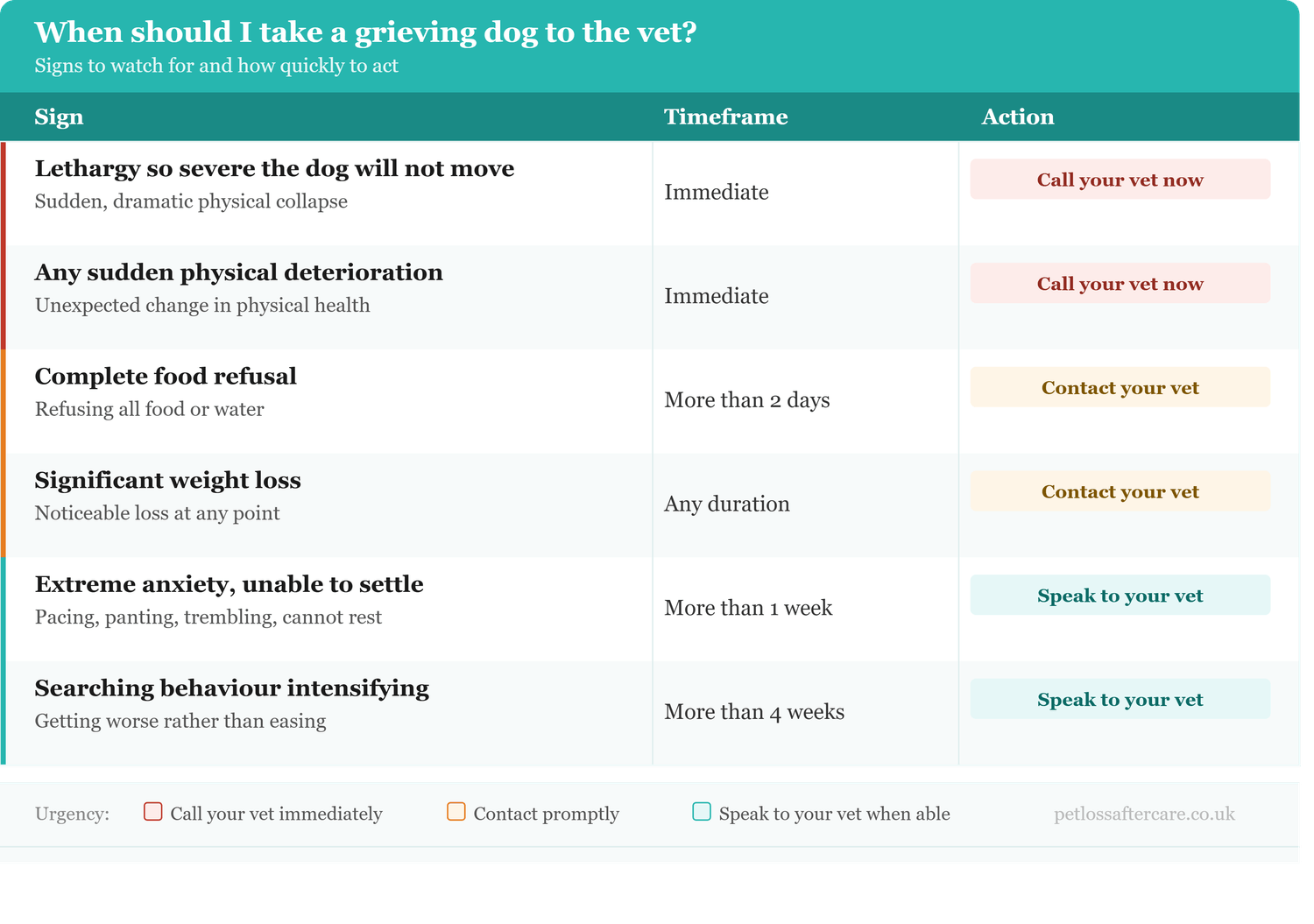
When should I consider professional support for a grieving dog?
If the dog's grief-related behaviour is severe, persistent, or beginning to affect their physical health - significant weight loss, complete food refusal, extreme anxiety - speak to a vet.
Your vet can rule out underlying physical causes for the behaviour and advise on the right support. They can also refer you to a veterinary behaviourist if the dog's distress requires more structured intervention.
The Animal Behaviour and Training Council (ABTC) maintains a register of accredited practitioners across the UK at abtc.org.uk.
What Happens To A Dog Legally When Their Owner Dies In The UK?
This is a question that family members and friends often face in the immediate aftermath of a loss, and it deserves a clear answer.
What does UK law say about dogs when an owner dies?
Under English law, pets are personal property - they have no legal rights and cannot hold assets. When their owner dies, pets pass into the estate alongside furniture, jewellery, and other chattels. The executor or administrator has the authority to decide what happens to them, unless the will specifies otherwise.
In plain terms: the dog legally belongs to whoever inherits them under the will, or to whoever the executor decides should care for them if there is no specific provision. Without clear instructions, a dog could end up with someone unable or unwilling to care for them, or caught between family members who cannot agree.
What happens to a dog if there is a will?
If the deceased left a valid will, the dog will pass to the person specifically named as the beneficiary or caretaker.
If no such provision exists, the executor of the estate typically decides who will care for the dog, often arranging for a family member or friend to take ownership. In cases where no suitable arrangements can be made privately, the dog may be re-homed through animal charities or rescue organisations.
It is also possible to leave money in a will for the dog's care - not directly to the dog (animals cannot hold assets in UK law), but as a cash sum to a named caretaker, or more formally through a pet trust, which gives trustees legal obligations to apply funds specifically for the animal's welfare.
What happens to a dog if there is no will?
If the owner died intestate - without a will - the estate is distributed according to the rules of intestacy, and the dog is treated as any other piece of personal property.
In practice, family members usually make arrangements between themselves, but there is no legal framework to enforce those arrangements or to ensure the dog's welfare is the primary consideration.
Which UK charities can help when a dog's owner dies?
If family members cannot take the dog in, or if the owner lived alone and no arrangements were made in advance, several UK charities provide support:
The Dogs Trust Canine Care Card
A free scheme for dog owners. The owner registers and carries a card so that anyone finding the owner deceased knows to contact the Dogs Trust, who will care for and if necessary rehome the dog. Free to register at dogstrust.org.uk.
The Cinnamon Trust
The only specialist national charity for the terminally ill and people in their later years and their much loved companion animals.
They operate through a network of over 15,000 community volunteers and can provide temporary fostering during hospital stays and long-term rehoming support when an owner dies. Particularly relevant for owners who are elderly or terminally ill and want to plan ahead. Register at cinnamon.org.uk.
Blue Cross
Offers emergency fostering for dogs and other animals whose owners have died unexpectedly, where no other arrangements are in place. bluecross.org.uk.
The Role of Pet Bereavement Counselling → How It Can Help and Where to Find Support
Frequently Asked Questions
Do dogs know when their owner has died?
Dogs do not understand death as a concept, but they register the permanent absence of someone they were bonded to. They notice the absence of familiar scent, voice, and routine. Whether that constitutes "knowing" in the way humans mean the word is a question science cannot yet fully answer - but the behavioural evidence strongly suggests that dogs experience something real and significant when their primary person does not return.
Should I show a dog the body of their deceased owner?
This is a personal and practical decision. Some veterinary behaviourists believe that allowing a dog to investigate the body of their owner - where this is safe, appropriate, and something the family is comfortable with - can help the dog process the permanence of the absence and reduce prolonged searching behaviour. There is no obligation to do this, and it is not the right choice for every situation. If you are uncertain, speak to your vet.
How do I help a dog bond with me after their owner has died?
Be patient, consistent, and low-pressure. Give the dog time to grieve before expecting them to attach to you fully. Maintain their routine as closely as possible, keep any familiar objects and scents from their previous home, and allow them to come to you rather than forcing interaction. Most dogs, given time and a stable environment, do form new primary attachments. Some take weeks. Others need months. Both are normal.
Will a dog ever get back to normal after losing their owner?
Most dogs do - though "normal" may look slightly different after a significant loss. With consistent care, routine, and time, the majority of dogs gradually return to something close to their previous personality. Some become closer to their new caregivers than they were even with their original owner, particularly if the new environment is more active or more social. A small number of dogs show prolonged responses, particularly those who were very exclusively bonded to one person. If you are concerned about your dog's progress, speak to your vet.
Should I get another dog to help them cope with the loss of their owner?
Not immediately, and not as a substitute for addressing the grief directly. A new dog can eventually be a positive addition - particularly for social dogs with strong companionship needs - but introducing a new animal into a household where a dog is already distressed can add stress rather than relieve it. Wait until your dog's behaviour has stabilised before considering this, and consult your vet before making the decision.
How is a dog grieving their owner different from separation anxiety?
This is a question vets are asked regularly, and the distinction matters because the treatment approach differs. Separation anxiety is triggered by the absence of an attachment figure and resolves when that person returns. Grief is a response to permanent loss. A dog who is grieving may show similar surface symptoms - anxiety, vocalisation, appetite loss - but these persist regardless of whether other familiar people are present, and they tend to ease gradually over time rather than cycling with each absence. If you are unsure which your dog is experiencing, your vet or a veterinary behaviourist can help you distinguish between the two.
Healing Takes Time For Both You And Your Pet
If you are caring for a dog while also grieving the person who died, you are carrying something significant. The dog's grief and your own are not in competition - you are both adjusting to the same absence, at your own pace.
Looking after the dog can give purpose and structure during a period when both feel in short supply. And with time, the dog can become a source of comfort rather than only of sadness.
For guidance on your own grief following the loss of a pet or a person, our guide to Pet Bereavement Counselling explains how to find a counsellor who understands animal loss.
For practical aftercare guidance, visit Pet Loss Aftercare - a free UK resource for anyone navigating the loss of a companion animal.
For practical guidance and support around pet loss visit our Pet Loss Resources and Guidance page.
This article is written for informational purposes and does not constitute veterinary or legal advice. For advice specific to your situation, contact a qualified veterinarian or solicitor.
Sources:
Psychology Today - Do Our Dogs Miss Us When We're Gone? - https://www.psychologytoday.com/gb/blog/the-mysteries-of-love/202408/do-dogs-grieve-and-miss-their-loved-ones
Blake Morgan Solicitors (2026) - Law vs. love: protecting your pet in your will. blakemorgan.co.uk
WillSafe (2026) - What happens to pets when you die UK. willsafe.org.uk
Dogs Trust - Canine Care Card scheme. dogstrust.org.uk
The Cinnamon Trust - National charity for elderly and terminally ill people with pets. cinnamon.org.uk
Blue Cross - Emergency pet fostering. bluecross.org.uk
Animal Behaviour and Training Council (ABTC) - abtc.org.uk
Need To Find A Pet Crematorium Near You?
If you have recently lost a pet and need to find a pet cremation service, Pet Loss Aftercare can help during this difficult time.
When you feel ready, you can browse pet cremation and aftercare providers by location to see what services are available in your area.
Pet Cremation Providers In England
- Bedfordshire
- Berkshire
- Bristol
- Buckinghamshire
- Cambridgeshire
- Cheshire
- Cornwall
- Cumbria
- Derbyshire
- Devon
- Dorset
- Durham
- East Riding of Yorkshire
- East Sussex
- Essex
- Gloucestershire
- Greater London
- Greater Manchester
- Hampshire
- Herefordshire
- Hertfordshire
- Isle of Wight
- Kent
- Lancashire
- Leicestershire
- Lincolnshire
- Merseyside
- Norfolk
- North Yorkshire
- Northamptonshire
- Northumberland
- Nottinghamshire
- Oxfordshire
- Rutland
- Shropshire
- Staffordshire
- Somerset
- South Yorkshire
- Suffolk
- Surrey
- Tyne and Wear
- Warwickshire
- West Midlands
- West Sussex
- West Yorkshire
- Wiltshire
- Worcestershire
Pet Cremation Providers In Scotland
Pet Cremation Providers In Wales
Pet Cremation Providers In Northern Ireland
Do you provide pet cremation services in the UK?
Pet Loss Aftercare - a resource created by pet owners, for pet owners 💛
Found this page helpful?



Created with ©systeme.io